

The Difference in Weapon Arts
| Most martial arts instructors in the area are unaware of what “Weapon Arts” means or what depth and breadth of such arts is possible. |
| Students
in these competition-oriented schools are often unaware of the poor quality of their own and their instructors' skills. The blind are often judging the blind, as it were. |
While the weapon skills taught as part of traditional styles, on the other hand, are usually of good quality, they are often times limited in diversity of weapons and/or amount of content. They also often require the student to be at a high level of the associated empty-hand art to understand or be allowed to participate in the weapons instruction.
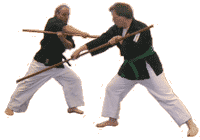 ...how
to use a staff, stick, sword, knife, spear, etc., to decisively
stop an attacker. ...how
to use a staff, stick, sword, knife, spear, etc., to decisively
stop an attacker. |
The Weapon Arts program at Budo consists of high quality, practical, self-defense-oriented training in a variety of separate, but often related, traditional Weapon Arts—That is, how to use a staff, stick, sword, knife, spear, etc., to decisively stop an attacker. They are designed to be taught separately and do not require any particular empty-hand knowledge, (though one's skills in both areas are enhanced when one studies both concurrently). The arts in the program originate from a variety of traditional styles and students can direct their own path, but the core foundation of the program is a formalized elite Okinawan weapons style known as Matayoshi Kobudo, which contains 14+ weapons itself.
In addition to training individuals who are interested in learning real quality Weapon Arts, part of the aim of the Budo Weapon Arts Program is to raise the awareness of what quality Weapon Arts are and to propagate the teaching of these arts so that the quality of weapons training in general is increased.
| Part of the aim of the Budo Weapon Arts Program is to raise the awareness of what quality Weapon Arts are. |
Check out ...
Elite Weapon Arts (Kobudo) at Budo